
 Share on bsky
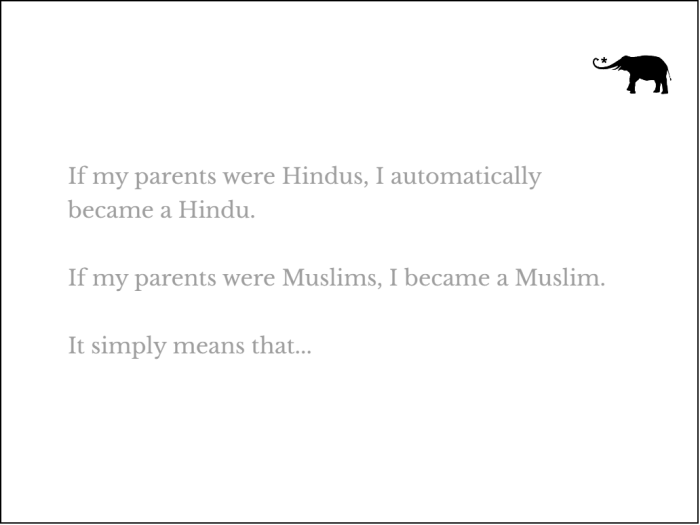
From the moment of my birth, the family into which I arrived was a matter of chance. If my parents practiced Hinduism, I was deemed a Hindu. If they followed the Islamic faith, I was labeled a Muslim. This illustrates that the religion assigned to me at birth was beyond my control, and my atma – my soul, bore no inherent religious stamp.
This prompts a series of profound questions: How does one specific religion become “my” religion or “your” religion? When does it cross the boundary from being just a faith to a personal identity? The plea arises, “Kill me for YOUR religion, you said?” [ POEM ]
It’s a call to recall our past lives, to remember that the Hindu of today may have been a Muslim in a prior existence, and the Muslim, perhaps a Christian. Have we forgotten these shared experiences? Why, then, are we engaged in the tragic act of taking the lives of our own brothers and sisters in the name of religion?
The poem serves as a poignant reminder that religion was conceived by us as a means to express love for and remembrance of God in our own unique ways. It echoes the teachings of various faiths, from the Bible’s(Christianity) commandment to love one another to the Bhagavad Gita’s (Hinduism) declaration that we are all spiritual beings entitled to eternal love with a loving God. The Guru Granth Sahib Ji (Sikhism) further emphasizes that realization of God comes to those who embody love.
In contemplating these teachings, one can’t help but wonder what has transpired among us, human beings, to divert us from our shared path. In our diverse world, we’ve all been exposed to the same core teachings but in different ways. So why have we lost our way?
The poem challenges the notion that God can only be found through one’s own religion. It questions the idea that a specific faith is the exclusive conduit to God when God is omnipresent and omniscient. It forces us to examine the fairness of a God who would favor one group of believers over others, akin to a biased parent showing preference to some of their children.
The closing verses invite us to reflect on the cost of our actions: How many more lives must be sacrificed to realize the omnipresence of God? How many more brothers and sisters must we harm in the name of religion before we awaken to these universal truths? It is a plea to direct these questions inward, to our own souls, and to wonder whether we have indeed reached a state of awakening.
In sum, this poem challenges us to look beyond the labels of religion and recognize our shared humanity- awaken to the fact that we all are just SOULS. It beckons us to foster unity and embrace diversity. The message resounds: spirituality transcends boundaries, and it is high time we awaken to this universal truth.
 Leave a Thoughtful Comment





Read 0 comments and reply